
This article reviews recent scientific discussions and emerging research related to chitosan, microplastic binding, gastrointestinal support, and digestive wellness. This content is educational only and should not be interpreted as medical advice.
Microplastics are now found in:
As concern around environmental toxin exposure grows, researchers are increasingly studying dietary compounds that may help support the body’s natural elimination pathways.
Among the most discussed materials is chitosan, a positively charged biopolymer derived from:
Recent studies suggest certain forms of chitosan may help:
However, not all forms of chitosan behave the same way.
Research indicates that:
all influence performance.
This review explains:
Microplastics are plastic particles smaller than 5 mm.
They originate from:
Researchers now recognize that human exposure occurs continuously through:
| Source | Common Plastic Types |
|---|---|
| Bottled Water | PET, PP |
| Seafood | PE, PET |
| Airborne Fibers | Rayon, Polyester |
| Processed Food Packaging | Mixed polymers |
| Salt & Drinking Water | PE, PP |
Emerging research suggests microplastics may influence:
Studies have explored associations between microplastics and:
This area is still developing, but interest is increasing rapidly.
Chitosan is a naturally occurring cationic biopolymer created through the deacetylation of chitin.
It contains positively charged amino groups that make it unique among dietary fibers.
Often preferred for dietary supplement applications because it is:
A newer premium source known for:
Historically common, though concerns are increasingly raised regarding:
Yes.
Chitosan is generally considered a nondigestible dietary fiber because human digestive enzymes do not fully break it down in the upper gastrointestinal tract.
This allows it to:
Like other dietary fibers, some forms may be partially fermented by intestinal microbiota.
This is where scientific discussion becomes more nuanced.
A true prebiotic is generally defined as:
A nondigestible compound selectively utilized by beneficial microorganisms that produces a measurable health benefit.
Research suggests chitosan and chitosan oligosaccharides may:
However, evidence in humans remains mixed.
At the present time, the most scientifically accurate description is:
Chitosan is a nondigestible fiber with emerging prebiotic potential.
It may support microbiome balance, but current evidence is not yet as strong or established as classic prebiotics such as:
One reason researchers are interested in chitosan is its unique positive charge.
Microplastics and environmental contaminants may carry:
This creates the potential for interaction with protonated chitosan.
Positively charged chitosan may interact with negatively charged surfaces.
Hydroxyl and amino groups may contribute to molecular interactions.
Certain molecular weights of chitosan form viscous gels that may physically entrap particles.
The gel structure may help support elimination through the GI tract.
Not all chitosan behaves identically.
Research frequently highlights:
as critical functional variables.
Many recent studies discussing microplastic interaction focus on:
These specifications appear to balance:
Beyond microplastic research, chitosan is increasingly discussed for broader digestive wellness support.
Potential functional roles include:
Some formulations combine chitosan with:
to create more comprehensive digestive support systems.
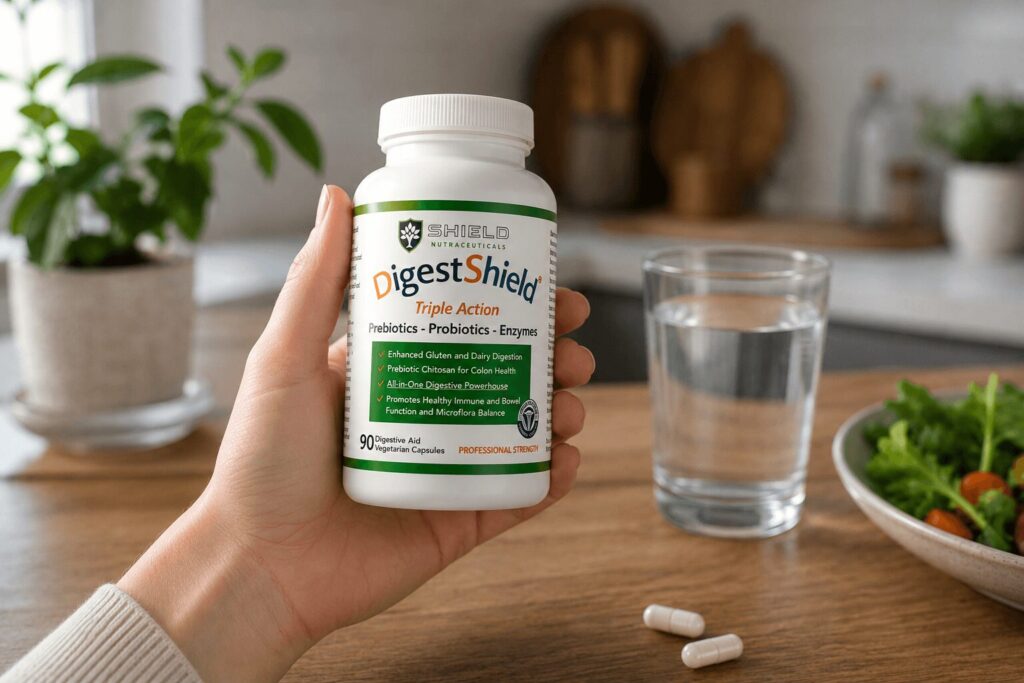
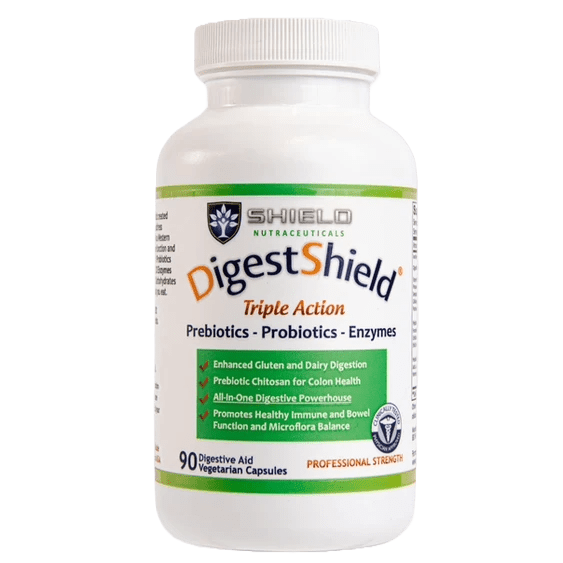
DigestShield® is an example of a broader digestive wellness formula that combines:
The formula is designed to support:
This combination represents a more modern “gut system” approach rather than relying on a single ingredient.
Purity is extremely important for dietary chitosan.
Consumers should look for:
✔ Mushroom-derived chitosan
✔ BSF insect-derived chitosan
⚠ Shellfish-derived chitosan due to:
Chitosan research also explores possible roles in:
Additional research is still needed for many applications.
Although interest is growing rapidly, important limitations remain.
Future research will likely focus on:
If considering chitosan supplementation, consumers should prioritize:
Look for mushroom or BSF sources.
Verify heavy metal testing and purity.
Research-supported specifications are preferred.
Choose companies with:
Yes. Chitosan is generally considered a nondigestible dietary fiber.
Evidence is still developing. It may have prebiotic-like effects, but current human evidence is not yet as strong as classic prebiotics.
Emerging studies suggest certain forms of chitosan may support microplastic interaction and excretion in the GI tract.
Yes. Molecular weight strongly influences gel formation, viscosity, and functional behavior.
Mushroom-derived and BSF-derived chitosan are increasingly preferred due to purity and safety advantages.
Scientific interest in chitosan is expanding rapidly because of its unique combination of:
Current evidence suggests chitosan may function as:
However, the science continues to evolve.
The most accurate scientific interpretation today is:
Chitosan is a nondigestible functional fiber with emerging prebiotic and gastrointestinal support potential.
As research progresses, higher-purity mushroom and BSF-derived chitosan systems may become increasingly important in future gut health and environmental wellness strategies.
This article was developed using recent scientific literature and publicly available research discussing:
Readers should consult original peer-reviewed publications for detailed methodologies and clinical interpretations.

Etiam magna arcu, ullamcorper ut pulvinar et, ornare sit amet ligula. Aliquam vitae bibendum lorem. Cras id dui lectus.
63739 street lorem ipsum City, Country
+12 (0) 345 678 9
info@company.com
Take the first step towards a happier gut. Get 5% de descuento your next purchase of DigestShield.